Why your systems don't talk to each other (and how to fix it)
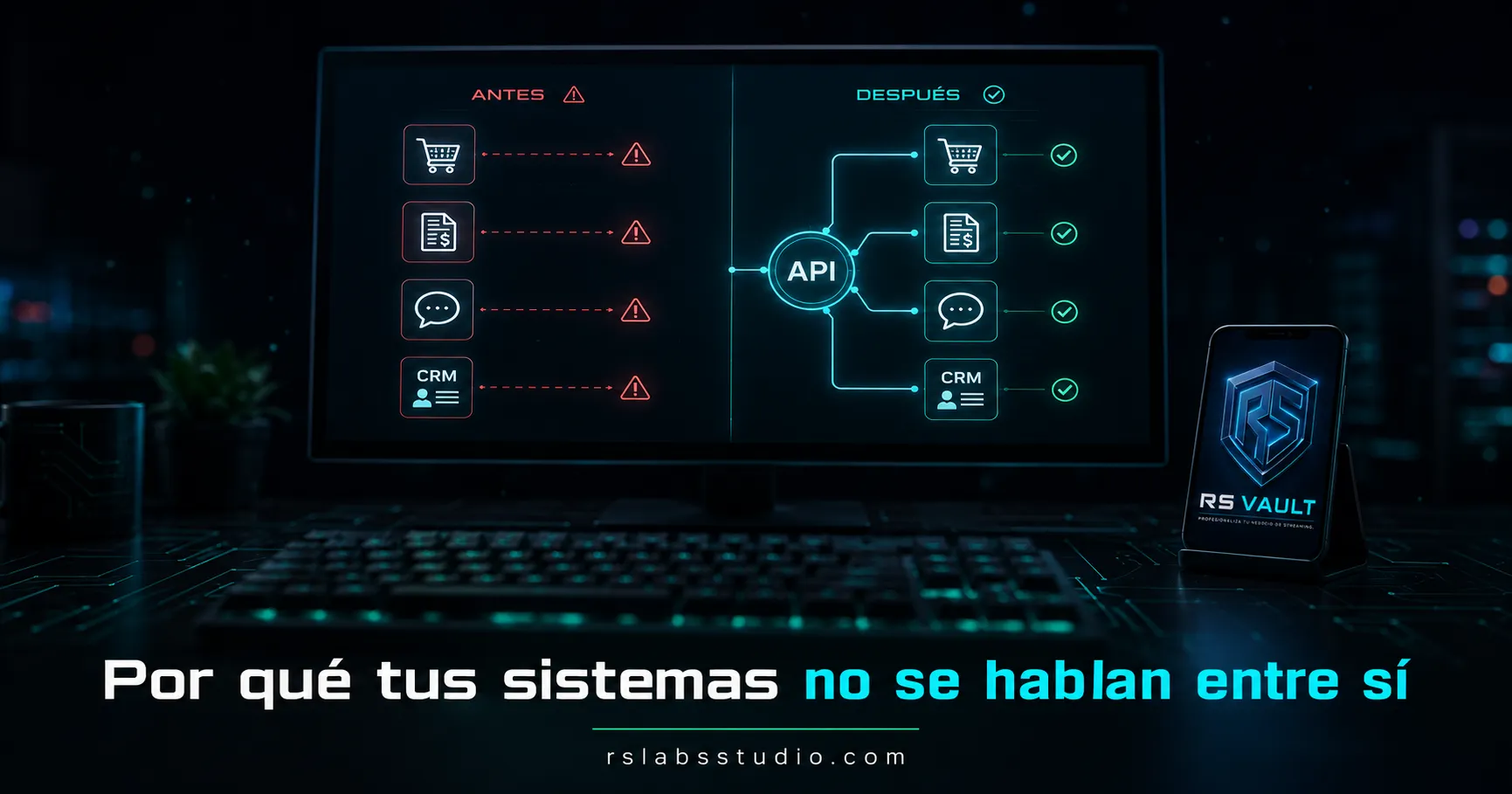
It's a pattern we see constantly: a company using 4 or 5 different tools — a CRM for sales, an e-commerce platform, an invoicing system, WhatsApp Business for customer service — and none of them know the others exist. Someone has to manually copy data from one to another, every single day.
What this looks like in practice
A customer buys from your online store. Someone has to copy their details into the invoicing system to issue the receipt. Then someone else copies them into the CRM for post-sale follow-up. If the customer writes on WhatsApp, nobody in the CRM knows unless someone writes it down by hand. Three people, three manual copies, three chances for error.
Why this happens so often
Every tool you use was designed by a different company, to solve a different problem, without thinking about the other tools you use. They come "closed" by default — unless someone explicitly connects them through their API, they work as separate islands.
What an API actually is (without the jargon)
An API is basically a "translator" that lets two different systems understand each other. When your online store and your invoicing system are connected via API, a new order in the store automatically generates the invoice, without anyone copying anything by hand.
What changes when you connect your systems
An order in your store automatically generates the corresponding invoice. A new client in your CRM automatically syncs with your WhatsApp Business list. A payment recorded in your gateway automatically updates the order status everywhere. Your sales reports build themselves, pulling data from every source at once.
You don't always need to switch tools
A common mistake is thinking the solution is "migrate everything to a new system that does it all". Most of the time that's not necessary — your current tools probably already have an API available, someone just needs to connect them correctly. Switching tools is expensive, slow and risky. Connecting the ones you already have is usually faster and cheaper.
When it's actually worth building something custom
If no tool on the market does exactly what you need, or if your processes are specific enough, that's when it makes sense to build your own layer that connects everything under your control, instead of depending on generic third-party integrations.
At RS Labs Studio we connect the tools you already use — or build the custom integrations you need — so your systems work together instead of living isolated. Tell us what tools you use today and we'll show you how easy it is to connect them.