MVP: what it is and why your SaaS should start there
"I want to build a SaaS" is one of the phrases we hear most. And it almost always comes with a very long feature list: dashboard, user roles, automatic billing, notifications, integration with fifteen other tools. The problem isn't ambition — it's the order.
The trap of building the "complete product" from day one
When someone tries to build the final version of their SaaS before launching it, two things almost always happen: development takes 6-8 months instead of 6-8 weeks, and when it finally launches, many of those features go unused because they were built on assumptions, not real usage.
What an MVP actually is
MVP stands for "Minimum Viable Product" — it's not an incomplete or low-quality version, it's the simplest version of your product that already solves the main problem and that someone would pay to use. Nothing more. No "nice to haves", no features that "will surely be needed later".
A concrete example
If your idea is a scheduling SaaS for clinics, your MVP doesn't need: advanced reports, multiple languages, a native mobile app, or integrations with 5 payment gateways. It needs: a patient can book an appointment, the clinic can see it on a calendar, and both get a confirmation. That's already a product someone can pay for.
Why this actually saves you money
Every feature you add before validating that the product works is a bet. If you build 20 features and only 4 end up being the ones your users actually use, you spent 80% of the budget on things that didn't matter. Starting with an MVP flips that logic: you spend little, you learn fast, and you only invest heavily in what you already know works.
What the right process looks like
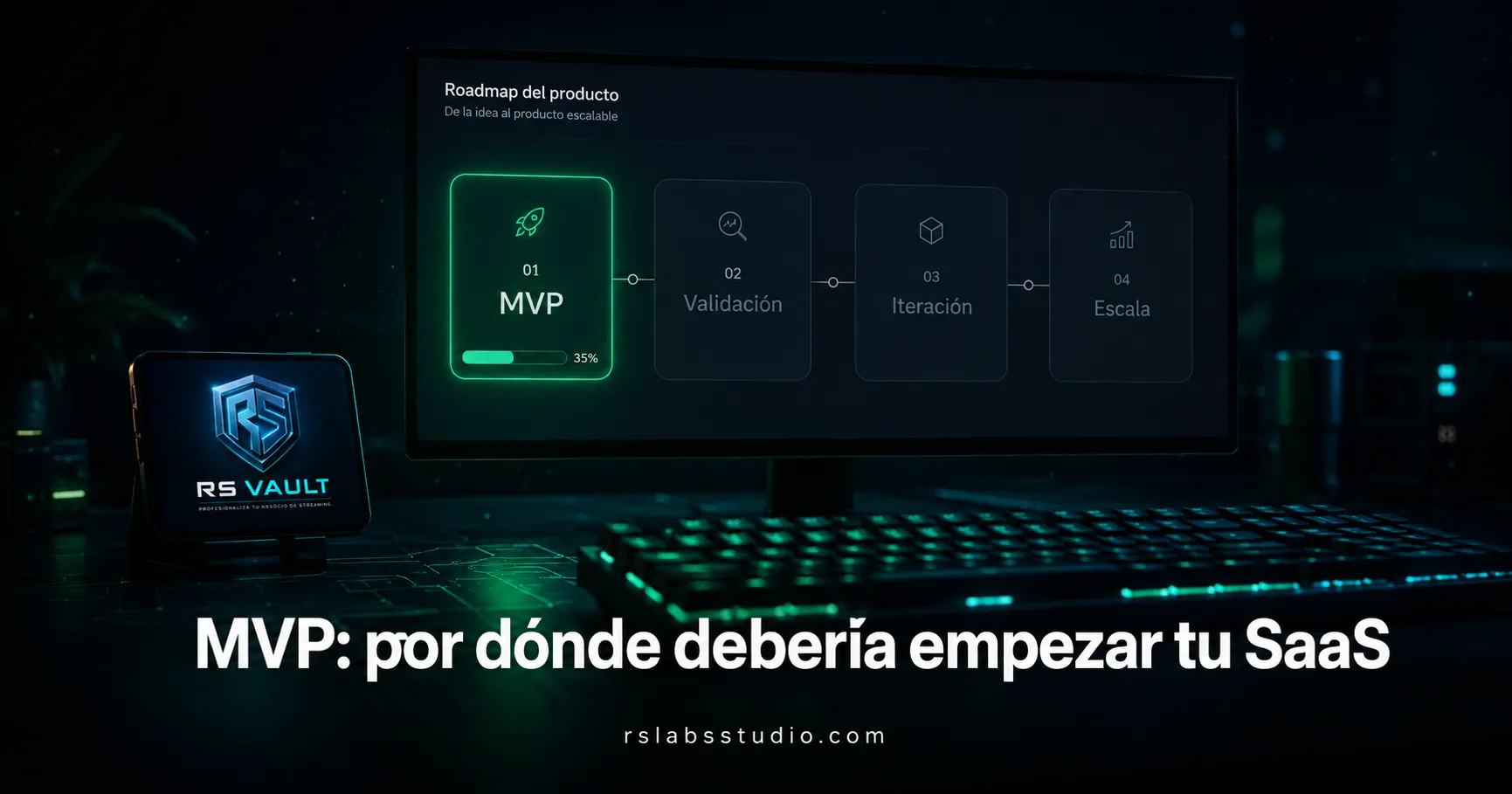
Phase 1 — MVP: the minimal version that solves the core problem. Weeks, not months. Phase 2 — Validation: you test it with real users, not with your opinion or your friends'. Phase 3 — Iteration: you add exactly what the data and feedback ask for, not what you imagined at the start. Phase 4 — Scale: with a validated product, that's when it makes sense to invest in robust architecture, full multi-tenancy, advanced automations.
The mistake of waiting to have "everything ready" to launch
The longer you spend building in silence, the longer you go without knowing if your idea actually has a market. Launching fast with the minimum isn't a technical limitation — it's a strategic decision to learn from real data instead of assumptions.
At RS Labs Studio we build your SaaS MVP with this in mind: architecture that allows scaling later, but without spending time and budget on features you don't yet know if you'll need. If you have a SaaS idea, tell us your case and we'll help you define what your real MVP is.