CRM vs Excel: why your business needs to switch
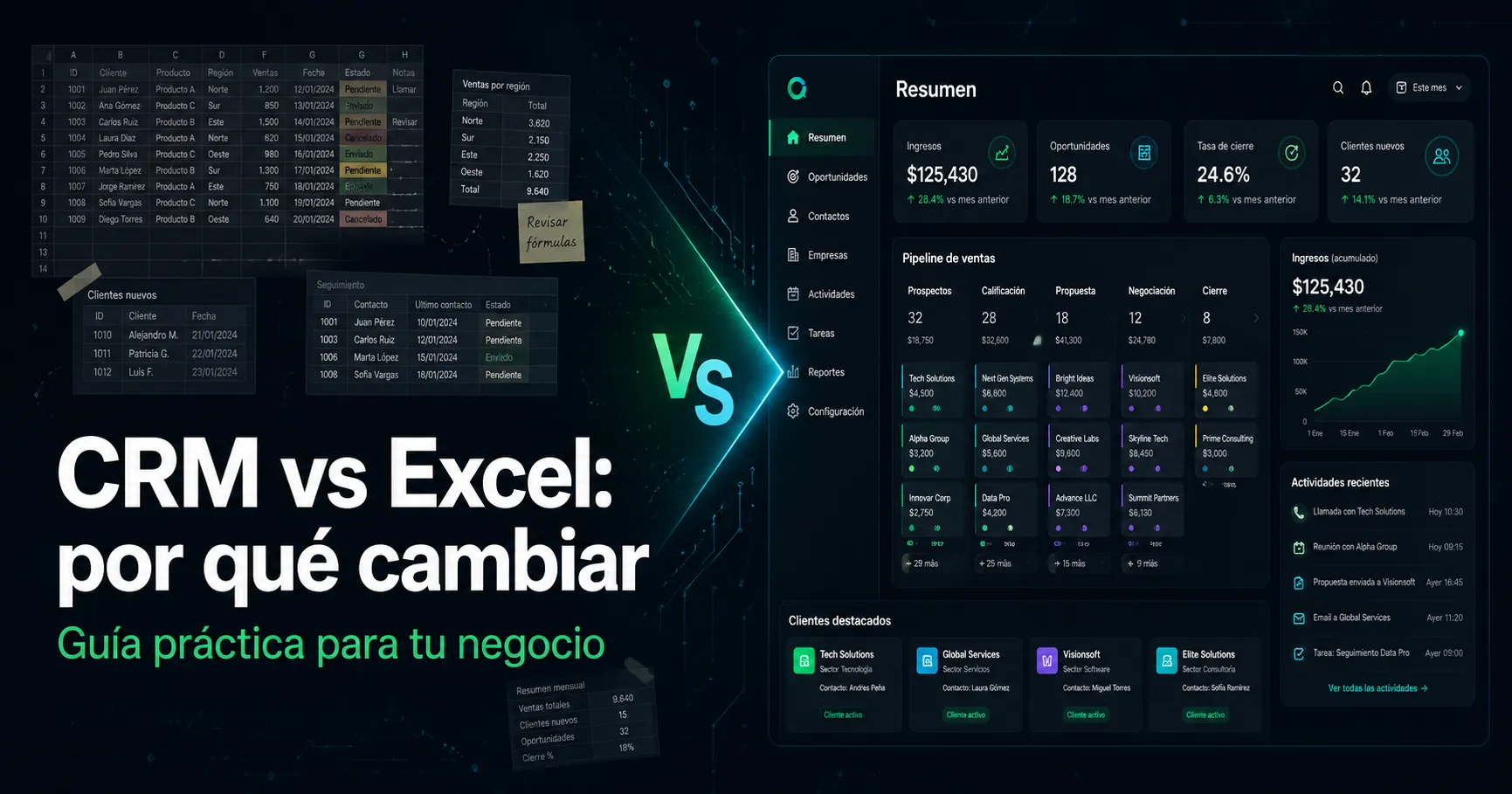
Almost every business starts the same way: a spreadsheet with names, phone numbers, and a "status" column. It works well... until it doesn't. And the dangerous part is it stops working before you even notice.
The illusion that "it's still under control"
Excel doesn't warn you when something's wrong. It doesn't tell you that a client has gone 20 days without follow-up, it doesn't alert you when two salespeople are talking to the same person without knowing it, it doesn't show you how many sales you lost by not calling in time. The file looks organized, but the valuable information only lives in the memory of whoever fills it in.
Signs you already need it
If you answer "yes" to two or more of these, it's time to switch:
Have you ever lost track of a client because you couldn't remember where things stood? Does your sales team each use their own spreadsheet or WhatsApp? Can you not immediately answer how many sales you closed this month? Has a client ever complained that "nobody got back to them"? Do you make decisions based on gut feeling because you don't have real data?
What a CRM actually is
A CRM (Customer Relationship Management) isn't "a prettier Excel". It's a system that centralizes every interaction with every client: when you contacted them, what you offered, what stage they're at, what's left to close the deal. Your whole team sees the same up-to-date information in real time, without relying on someone "letting them know on WhatsApp".
What changes in practice
With a well-implemented CRM, you stop losing clients due to lack of follow-up, your team knows exactly what to do with each contact without having to ask you, you have real sales reports without building a pivot table by hand, and you can identify exactly where in your pipeline you're losing the most opportunities to fix it.
Do you need a generic CRM or a custom one?
Generic CRMs (Hubspot, Salesforce, Pipedrive) work well for standard processes, but charge per user monthly and often include modules you'll never use. If your sales process has specific quirks (local invoicing requirements, specific integrations, your own approval flows), a custom CRM ends up being cheaper in the long run and fits exactly how your team works, without overpaying for features you don't need.
The real cost of not switching
It's not the cost of the system that should worry you, but the cost of continuing without one: every client you lose due to lack of follow-up is money you already spent to attract them, gone because a spreadsheet nobody checked in time.
At RS Labs Studio we build custom CRMs that fit exactly your sales process, not the other way around. If you want us to look at your case, tell us how you work today and we'll show you what it would look like solved.